

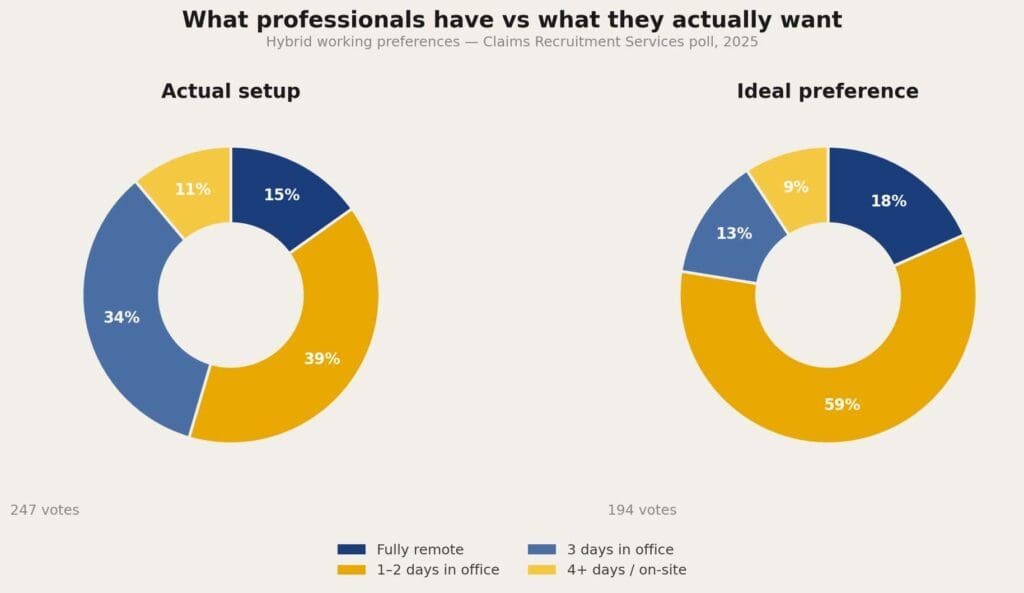
Hybrid working keeps coming up in conversations with clients and candidates. There’s a lot of noise about companies pushing for a stricter return to the office, so we wanted to see what’s actually happening on the ground.
We ran a two part poll across our network. First we asked what people’s actual office attendance looks like today. Then we asked what their ideal setup would be if the choice were entirely theirs.
Here are the results.
The data: actual vs ideal work patterns
| Working pattern | Actual setup (247 votes) | Ideal preference (194 votes) | The shift |
|---|---|---|---|
| Fully remote | 15% | 18% | +3% |
| 1 to 2 days in office | 39% | 58% | +19% |
| 3 days in office | 34% | 13% | -21% |
| 4+ days / fully on site | 11% | 9% | -2% |
Analysing the numbers
The 1 to 2 day gap
What stands out most is the 1 to 2 days in the office option. In our first poll, 39% said they currently do 1 to 2 days. Asked for their ideal preference, that jumped to 58%.
A number of our clients currently offer a 3 day office model as a middle ground. But only 13% of professionals say a 3 day week is their ideal. There’s a clear gap between what companies offer as standard and what the workforce actually wants.
The office still holds value
It’s worth looking at this from both sides. Professionals value flexibility, but they still want to come in. Only 18% of voters want to be fully remote. That means 82% still want a physical connection to the office for collaboration, culture and team building.
Real time market trends: 4 day weeks and part time requests
Alongside the hybrid debate, we’re seeing a steady rise in candidates asking for a 4 day working week or formalised part time hours.
- Compressed hours: working full time hours over 4 days instead of 5, keeping 100% of the salary in exchange for longer days.
- Pro rata / part time: reducing total hours and taking a proportional salary drop in exchange for an extra day of personal time.
Candidates are actively looking for this kind of flexibility. Companies open to accommodating these structures put themselves in a strong position to attract and hire good people.
What this means for recruiting
From a hiring perspective, there’s a clear takeaway.
If a company offers 1 to 2 days in the office, or is open to structures like compressed hours, they hold a real advantage when it comes to attracting new employees. This lines up with what nearly 60% of the active market wants.
If a business model needs people in 3 or more days a week, that needs balancing elsewhere. To stay competitive and secure good talent, businesses will likely need to look at other parts of their package: a higher base salary, better bonus structures, or other benefits that matter to people.
If you’d like to know more about how hybrid working, flexibility and other benefits are shaping the insurance market, we’re always happy to talk.
hello@claimsrecruitment.co.uk / 0203 805 5534